peça MB outu 24 (muito desenvolvida)
(retrospetiva?)
Going Cashless
Following a revision to local laws to confirm the status of digital currency as Macao’s legal tender, the city is putting forward a work plan in three phases to test and pilot its digital fiat currency, e-MOP, with a public display of the prototype by year-end and a trial operation scheduled by the end of 2025.
By Tony Lai
With the waning use of cash in the post-Covid era and the emergence of cryptocurrencies, global economies have begun exploring the possibilities of central bank digital currency (CBDC) — digital money issued and backed by a central bank. In this direction, Macao has taken a significant step in recent times, unveiling a three-phase plan to test and pilot its digital fiat currency, e-MOP, prior to an official launch.
In September, the Macao government disclosed that it has worked with the Digital Currency Research Institute under the People’s Bank of China (PBOC) for the research and development of its CBDC. An e-MOP prototype will be ready for public display by year-end, coinciding with the 25th anniversary of the establishment of the Macao SAR, the authorities added.
In an interview with local media outlets, including Macao Business, Chan Sau San, Chairman of the Monetary Authority of Macao (AMCM), underscored this global trend where numerous countries and regions are investing in their digital fiat currencies amidst the rise of the digital economy and financial technology. Citing a Bank for International Settlements (BIS) survey, he noted that over 90 per cent of central banks worldwide are involved in some form of CBDC work.
Addressing the advantages of CBDC, Mr Chan pointed out, “It offers benefits such as reducing cash costs, promoting inclusive finance, enhancing the stability and efficiency of the financial payment system, and improving the transmission of monetary policy.”
CBDC is also distinct from decentralised cryptocurrencies like Bitcoin, which are issued by private entities. “[CBCC] would be backed by the issuing government, ensuring its value would be stable, unlike with crypto assets where large swings in value can happen for a number of reasons,” the international non-governmental think tank, the World Economic Forum, stated in a recent report.
In tandem with the global trend, the AMCM, Macao’s de-facto central bank, and the PBOC’s Digital Currency Research Institute forged a cooperation pact in September 2022 to advance the e-MOP initiative. Amendments to the Legal System for Currency Issuance last year also conferred legal tender status upon digital currency in Macao, laying the groundwork for the introduction of e-MOP.
“Our objective is… to construct a digital financial infrastructure for the digital transformation of Macao’s financial system, fostering a secure, efficient, and reputable legal currency framework,” Mr Chan stated.
“Whichever scenarios the MOP can be used in now, the e-MOP can be used in the future.”
— AMCM Chairman Chan Sau San

Retail/wholesale and soft/hard wallets
These efforts culminate in a public showcase of the e-MOP prototype featuring “basic functions” by year-end. The demonstration will illustrate the entire process of e-MOP issuance, exchange, payments, transactions, and settlements, complemented by the release of a white paper outlining the vision for the local digital fiat currency.
The AMCM chairman emphasised that the e-MOP represents both a novel and longstanding concept, serving as a new form of the existing fiat currency. “Whichever scenarios that MOP can be used now, the e-MOP can be used in the future,” he indicated.
The e-MOP has two primary applications: retail and wholesale. Retail application involves day-to-day usage by the general public, encompassing residents, tourists, enterprises, and government departments in various commercial settings. Wholesale application, on the other hand, pertains to transactions, settlements, and fund transfers among financial institutions.
Regarding the retail e-MOP, as outlined by the vision of AMCM, the public will have access to two types of wallets: soft and hard. Soft wallets are electronic wallets accessible through mobile applications, while hard wallets are integrated into smart devices. “The hard wallet could be integrated into smart devices or stored value cards, catering to the needs of the elderly and children,” Mr Chan advanced.
“We are actually ahead of many jurisdictions, as several have yet to update their laws to include digital currency in their monetary issuance framework.”
— AMCM Chairman Chan Sau San
Three phases of work
With a public showcase by year-end, the future e-MOP work will progress through three phases, according to the city’s de-facto central bank. The first phase concentrates on building the necessary infrastructure and core system, including establishing the technical architecture, defining functional scope, and designing the user interface, among other crucial elements.
The subsequent phase will involve internal trial operations through sandbox tests, gradually expanding the e-MOP utility to retail payments and beyond. “This phase will introduce updated rules and regulatory guidelines, along with new operating entities, in line with trial operation outcomes,” Mr Chan added.
In the third and final phase, comprehensive public testing will ensue. “Guided by relevant regulations, guidelines, and standards, and supported by a stable system, pilot testing will gradually integrate the e-MOP into diverse payment scenarios for the general public,” the official stated. In addition, exploration of integrating the e-MOP into cross-border payments and inter-bank settlements will also take place during this phase.
In July, the AMCM joined the mBridge project of BIS as an observing member. This project, initiated by the PBOC, Hong Kong Monetary Authority, and central banks from Thailand and the United Arab Emirates, aims to establish a multi-CBDC platform shared among central and commercial banks, facilitating instant cross-border payments and settlements.
Digital yuan and e-HKD
In light of the advancements in CBDC in neighbouring regions, Mr Chan remarked, “When our technology and conditions mature, we will prioritise exploring and promoting the integration of the e-MOP with other currencies in the Guangdong-Hong Kong-Macao Greater Bay Area, including the digital yuan and the digital Hong Kong dollar… facilitating cross-border payments and capital flows within the Greater Bay Area.”
Mainland China has indeed commenced trials of the digital yuan since 2020, introducing dedicated digital yuan wallets and mobile applications. Similarly, Hong Kong launched the digital Hong Kong dollar (e-HKD) project in June 2021 to assess the feasibility of issuing an e-HKD for individual and corporate use.
Nonetheless, the AMCM official did not confirm the timeline for the official launch of the e-MOP or specify timeframes for the three phases of preparing the digital fiat currency. “Numerous central banks globally are involved in CBDC research and development… but few have made significant progress,” he explained. “Hence, caution and prudence are critical as [the e-MOP] represents legal tender affecting each and every one of us.”
“We are actually ahead of many jurisdictions, as several have yet to update their laws to include digital currency in their monetary issuance framework,” he added.
In the world of CBDC development across 134 countries and regions, only three jurisdictions—Nigeria, The Bahamas, and Jamaica—have officially implemented their electronic fiat currencies, according to the Atlantic Council, an American think tank. On the other hand, 103 countries and regions, including Mainland China, Australia, and Japan, are currently in various stages of pilot programmes, development, or research.
However, the think tank noted that Senegal and Ecuador have abandoned their CBDC initiatives due to insufficient trust in the central bank and non-compliance with regulations.
“The e-MOP will enhance Macau’s existing payment and settlement system. Its programmability… and the unique feature of real-time settlement can pave the way for more efficient, cost-effective, and inclusive financial transactions and trade in Macau.”
— AMCM Chairman Chan Sau San
Beneficial to residents and businesses
The AMCM official also reiterated the advantages of developing the local CBDC. “The e-MOP will enhance Macao’s existing payment and settlement system. Its programmability… and the unique feature of real-time settlement can pave the way for more efficient, cost-effective, and inclusive financial transactions and trade in Macao,” he noted. “This can expedite new economic activities, laying the necessary groundwork for Macao’s high-quality development.”
The aspect of real-time settlement sets CBDC apart from mobile payments. For instance, merchants typically settle transactions with financial institutions after customers complete transactions via mobile payments. “With the e-MOP, transactions are instantly settled akin to cash… with zero credit risks,” Mr Chan illustrated.
Therefore, the official believes this local digital currency will benefit both the general public and businesses. “The e-MOP will not only diversify consumers’ payment options and reduce payment times due to its real-time transaction nature and legal tender status… but also assist local merchants in reducing operational costs,” he added.
Dual tiers
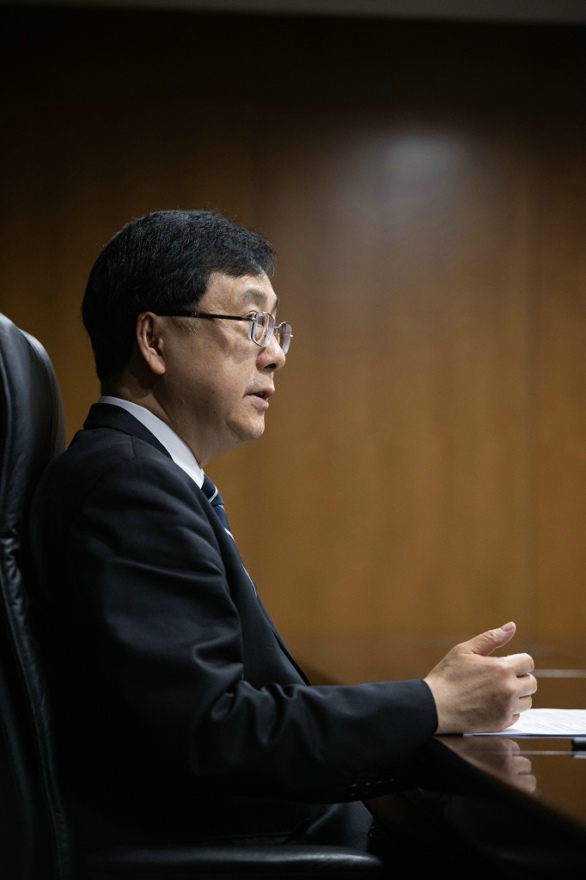
In the initial phase of the e-MOP project, Bank of China Macau Branch, one of the city’s two banknote-issuing banks, has been designated as the operating entity responsible for the development and testing of the customer portal of the system.
“[The e-MOP] mirrors our existing monetary issuance system, operating on a dual-layered structure,” explained Mr Chan. “[The e-MOP] signifies the monetary liability of the SAR government, backed by a 100 per cent reserve. Day-to-day operations, such as currency issuance to the public, will be managed by financial institutions.”
Besides BOC Macau, other financial institutions could potentially become operating entities for the e-MOP in the future by meeting specific criteria such as customer base size and capital value, he added.

“In contrast, the e-MOP, as a legal tender, is designed to accommodate citizens of all age groups. The e-MOP will particularly benefit the youth, elderly, and tourists, facilitating their seamless use of the e-MOP for everyday transactions and payments.”
— BOC Macau General Manager Jia Tianbing
Smooth progress
Regarding BOC Macau’s involvement in the e-MOP project, its general manager, Jia Tianbing, highlighted that the bank has conducted preliminary demonstration research and system development work. This includes the construction and testing of numerous use cases of the e-MOP. As the project “progresses smoothly,” BOC Macau is committed to continuously collaborating with AMCM for a public showcase of the e-MOP prototype by year-end, he added.
The e-MOP could commence trial operation for selected users and entities under whitelist (an approved list) management by the end of 2025, he added. In an interview with local media outlets, including Macao Business, he stated, “After initiating [the trial operation], we will gradually expand the e-MOP’s application scope and enhance the system’s functionality, supporting local economic development and showcasing tangible financial service achievements to the public.”
The rise in mobile payments in Macau aligns with the ongoing development of the e-MOP. In 2023, mobile payment transactions surged to 300 million in Macau, with a transaction value of MOP28.1 billion (US$3.5 billion), representing a notable increase of about 1,820 per cent and 2,300 per cent, respectively, compared to pre-Covid levels in 2019.
“The active promotion by the SAR government, the continual efforts of the financial sector, and the collaborative engagement of citizens and merchants have led to the maturation of Macau’s mobile payment systems,” stated the BOC Macau general manager. “The city is progressively transitioning towards a cashless society, showcasing Macau’s significant potential and achievements in the fintech sector.”
No bank accounts required
Despite the prevalence of mobile payments, the significance of the e-MOP is not to be overlooked. “The widespread use of mobile payment systems hinges on the support of the banking account infrastructure. Hence, strict adherence to a series of laws and compliance standards is imperative to ensure the security and stability of these payment systems,” he articulated.
“[But] children under 12 years old are not allowed to open bank accounts, the elderly are less familiar with mobile payments, and tourists face challenges accessing local bank accounts. These demographics encounter specific obstacles that hinder their adoption of mobile payments, impacting their daily routines and spending experiences,” he elaborated.
“In contrast, the e-MOP, as a legal tender, is designed to accommodate citizens of all age groups,” the banker added. “The e-MOP will particularly benefit the youth, elderly, and tourists, facilitating their seamless use of the e-MOP for everyday transactions and payments.”
Connecting to the world
The BOC Macau general manager also highlighted the bank’s experience in the CBDC work. While BOC Macau is one of the two banknote-issuing banks in the city, its parent company, Bank of China (BOC), actively contributes to the development of the digital yuan in mainland China.
For instance, Jia mentioned that BOC assisted over 40,000 merchants in accepting both digital and physical wallets of the digital yuan during the 2022 Winter Olympics in Beijing. “This enabled local residents and visitors [in Beijing] to transact conveniently using the digital yuan without the need to open a bank account,” he noted, suggesting a similar scenario could unfold in Macau. “This example closely aligns with Macau’s position as the ‘World Centre of Tourism and Leisure’,” he added.
The city also stands to gain from the e-MOP’s development, considering that digital finance is a global trend, with mainland China and Hong Kong advancing in the creation of their respective digital fiat currencies. “The introduction of the e-MOP can seamlessly integrate Macau into the economic and social development of the Guangdong-Hong Kong-Macau Greater Bay Area without obstacles,” he elaborated.
“The development of the digital economy is a global phenomenon,” the BOC Macau executive remarked. “Thus, the e-MOP represents a small stride for Macau but a significant leap towards global connectivity.”

Comments
Post a Comment